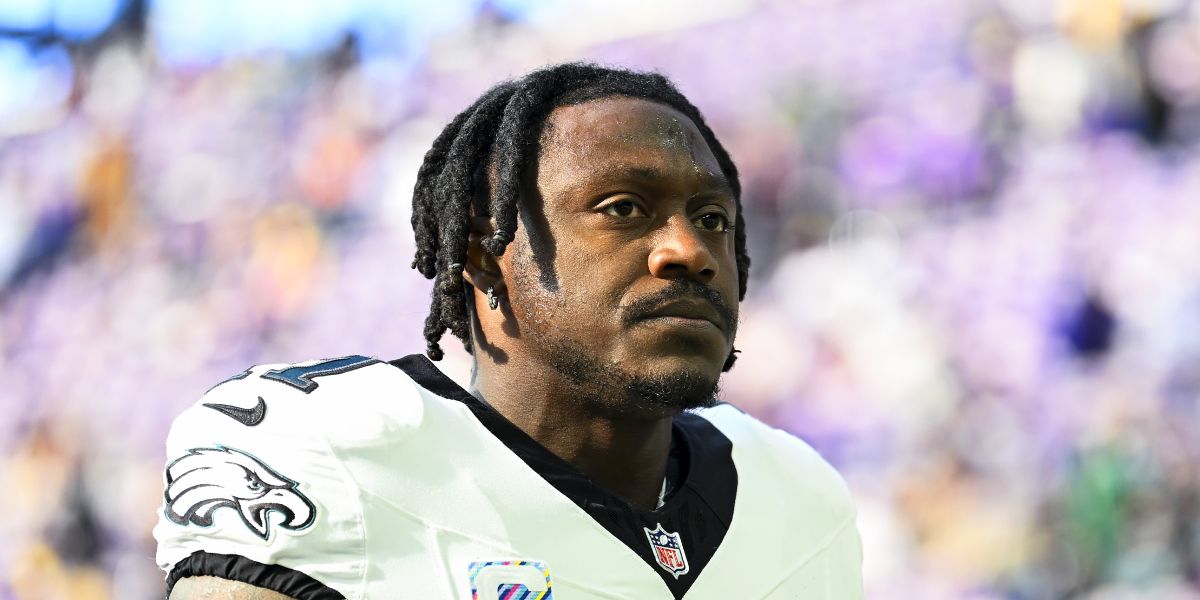
Aaron Hernandez | Source: Getty Images
Aaron Hernandez Signed a $40 Million NFL Contract – Less Than Five Years Later, He Died a Convicted Murderer at 27 With a Message on His Prison Cell Wall

Aug 28, 2026 - 04:42 A.M.
At just 22, the tight end had secured a contract worth up to $40 million with the New England Patriots. His football career appeared to be reaching new heights, but within a year, his life took a dramatic turn.
Advertisement
For years, Aaron Hernandez's life had revolved around football, a game that took him from a Connecticut high school to packed college stadiums and, eventually, the New England Patriots.

Aaron Hernandez photographed speaking to the media after football practice on January 27, 2012. | Source: Getty Images
But what followed unfolded far from the stadium. A killing near his home drew investigators into Hernandez's life, ended his football career almost overnight, and eventually placed him before juries in two separate murder trials.

Aaron Hernandez of the New England Patriots celebrates a 12-yard touchdown in the third quarter against the New York Giants during Super Bowl XLVI at Lucas Oil Stadium in Indianapolis, Indiana, on February 5, 2012. | Source: Getty Images
Advertisement
From College Champion to a $40 Million NFL Deal
Long before Hernandez became a familiar face in New England, he had established himself as one of Connecticut's most promising young football players.
In 2007, he was named Connecticut's Gatorade Football Player of the Year while playing tight end for Bristol Central High School. He then headed to the University of Florida, where he played under Head Coach Urban Meyer and joined a team led by quarterback Tim Tebow.

Aaron Hernandez of the Florida Gators breaks a tackle during a game against the FAU Owls at Ben Hill Griffin Stadium in Gainesville, Florida, on November 17, 2007. | Source: Getty Images
Success came quickly. Hernandez and the Gators won the national championship during the 2008 season, and the following year, he became the first Florida player to win the John Mackey Award as college football's top tight end.
Advertisement
With his stock rising, Hernandez decided in January 2010 to leave Florida after three years and enter the NFL draft rather than return for his senior season.

Aaron Hernandez during the second quarter of the Gators' game against Charleston Southern at Ben Hill Griffin Stadium in Gainesville, Florida, on September 5, 2009. | Source: Getty Images
Then, less than a year after signing the deal, police arrived at his home while investigating a killing nearby.
The New England Patriots selected him in the fourth round on April 24, 2010. Three days later, Hernandez acknowledged that he had failed a drug test while at Florida, but once his rookie season began, his production helped establish him as an important part of the Patriots' offense.

Aaron Hernandez of the New England Patriots poses for his 2010 NFL headshot in Foxborough, Massachusetts. | Source: Getty Images
Advertisement
Alongside fellow rookie tight end Rob Gronkowski, Hernandez formed one of the NFL's most productive young tight end pairings. He finished the 2011 season with 910 receiving yards and seven touchdowns and was named a Pro Bowl alternate.
His performances helped make him part of a Patriots team competing at the highest level, and New England rewarded that rise on August 27, 2012, when Hernandez signed a five-year contract extension worth up to $40 million.

Aaron Hernandez of the New England Patriots on the sidelines as the clock winds down in his team's 42-14 victory over the Houston Texans at Gillette Stadium in Foxborough, Massachusetts, on December 10, 2012. | Source: Getty Images
At 22, he had gone from a decorated high school player to a college national champion and then to a long-term place in one of the NFL's most successful organizations. Then, less than a year after signing the deal, police arrived at his home while investigating a killing nearby.
Advertisement

Aaron Hernandez of the New England Patriots looks on during an NFL game against the Jacksonville Jaguars at EverBank Field in Jacksonville, Florida, on December 23, 2012. | Source: Getty Images
The Killing That Brought Police to Hernandez's Door
On June 17, 2013, a jogger discovered 27-year-old Odin Lloyd's body at an industrial park in North Attleboro, Massachusetts, about a mile from Hernandez's home. Lloyd, a semipro football player who had been dating the younger sister of Hernandez's fiancée, Shayanna Jenkins, had been shot multiple times.
The connection to Hernandez soon became central to the investigation. Prosecutors said Lloyd had last been seen at about 2:30 a.m. with Hernandez and two of his friends, Carlos Ortiz and Ernest Wallace, who were traveling in a rented silver Nissan Altima.

Aaron Hernandez is brought into Attleboro District Court in North Attleboro, Massachusetts, on July 26, 2013. | Source: Getty Images
Advertisement
Surveillance images from Hernandez's own security system later added another element to the case. According to a news report about the footage, prosecutors said images taken before 1 a.m. appeared to show Hernandez inside his home holding what looked like a firearm.
After Lloyd was picked up and later shot five times, footage showed Hernandez back at his house with Ortiz and Wallace at approximately 3:32 a.m. Court documents stated that Hernandez again appeared to have a gun in his left hand as he approached his basement door.
Police searched Hernandez's home on June 18, and eight days later, the NFL career that had seemed secure only months earlier effectively ended. Authorities arrested the tight end on June 26 and charged him with first-degree murder in Lloyd's death, as well as five weapons-related offenses.
Another charge followed in May 2015, when Hernandez was indicted for witness intimidation in connection with the 2013 shooting of Alexander Bradley.
Advertisement

Aaron Hernandez inside the courtroom of the Attleboro District Court in North Attleboro, Massachusetts, for his hearing on August 22, 2013. | Source: Getty Images
He pleaded not guilty and was held without bail, while the Patriots released him less than two hours after his arrest. As the murder case worked its way toward trial, Hernandez remained behind bars and encountered further legal trouble.
He allegedly threatened a jail employee in November 2013 and was involved in an altercation with another inmate in February 2014, incidents that subsequently led to additional charges.
By then, however, investigators were also pursuing another case that would place Hernandez at the center of two more killings.

Aaron Hernandez at Attleboro District Court in North Attleboro, Massachusetts, on August 22, 2013. | Source: Getty Images
Advertisement
A Murder Conviction Followed by a Second Trial
On May 15, 2014, Hernandez was charged with two counts of first-degree murder over the 2012 shooting deaths of Daniel de Abreu and Safiro Furtado in Boston. He pleaded not guilty to those charges, leaving him facing separate murder prosecutions while awaiting trial over Lloyd's death.
The Lloyd case reached a courtroom first. Opening statements began in Fall River, Massachusetts, on January 29, 2015, and after more than two months of testimony, the jury returned its verdict on April 15 — Hernandez was found guilty of first-degree murder and weapons charges.

Aaron Hernandez during the fifth day of his trial at Bristol County Superior Court House in Fall River, Massachusetts, on February 5, 2015. | Source: Getty Images
The conviction carried a mandatory sentence of life in prison without the possibility of parole, transforming the 25-year-old former NFL player into a convicted murderer less than three years after he had signed his multimillion-dollar Patriots extension.
Advertisement
Another charge followed in May 2015, when Hernandez was indicted for witness intimidation in connection with the 2013 shooting of Alexander Bradley.

Aaron Hernandez during trial at Bristol County Superior Court House in Fall River, Massachusetts, on April 6, 2015. | Source: Getty Images
Prosecutors believed Bradley had witnessed the events surrounding the de Abreu and Furtado killings and alleged that Hernandez shot him after Bradley made a remark about the double murder. The tight end pleaded not guilty.
The investigation into his death revealed what had been left behind inside the cell.

Aaron Hernandez during the trial for the murder of Odin Lloyd at Bristol County Superior Court House in Fall River, Massachusetts, on April 7, 2015. | Source: Getty Images
Advertisement
Nearly two years after his conviction for killing Lloyd, Hernandez returned to court to face the de Abreu and Furtado case. On April 14, 2017, the jury acquitted him of murdering both men and of intimidating Bradley. Hernandez had faced eight counts and was convicted of only one — illegal possession of a firearm.
For the football player, the verdict removed the possibility of two additional murder convictions, but it did not change the life sentence he was already serving for Lloyd's death. Then, just five days after the acquittal, correction officers approached his prison cell.

Aaron Hernandez during the trial for the murder of Odin Lloyd at Bristol County Superior Court House in Fall River, Massachusetts, on April 7, 2015. | Source: Getty Images
What Was Written on Hernandez's Forehead and Prison Cell Wall?
Hernandez had been locked inside his cell at the Souza-Baranowski Correctional Center shortly before 8 p.m. on April 18, 2017. According to the subsequent state police investigation, an officer last saw him at approximately 1 a.m. the following morning.
Advertisement
Around two hours later, an officer noticed a sheet hanging in front of the tight end's cell door. After asking Hernandez to remove it or respond and receiving no answer, the officer moved the sheet and saw Hernandez hanging from the window.

Aaron Hernandez appears in Suffolk Superior Court in Boston, Massachusetts, on February 14, 2017. | Source: Getty Images
Once officers entered, they tried to lift the football player to relieve the pressure before cutting him down and beginning chest compressions. However, Hernandez never regained consciousness and was pronounced dead after being found at approximately 3:05 a.m. on April 19. He was 27.
The investigation into his death revealed what had been left behind inside the cell. Hernandez had a fresh cut on his right middle finger, while "John 3:16" was written in ink across his forehead. On the wall, amid several drawings, investigators found the same biblical reference written in what appeared to be blood.
Advertisement

Aaron Hernandez during his double murder trial at Suffolk Superior Court in Boston, Massachusetts, on March 2, 2017. | Source: Getty Images
The ruling restored the conviction that had defined the final years of Hernandez's life.
Below the drawings sat a Bible opened to John 3:16, with the verse itself marked in blood. Three handwritten notes were also discovered beside the Bible, although descriptions of their contents were redacted from the state police report.

Aaron Hernandez during his double murder trial at Suffolk Superior Court in Boston, Massachusetts, on March 8, 2017. | Source: Getty Images
Advertisement
Investigators reviewed Hernandez's last five telephone calls and reported that he made no "apparent indication of an intent to harm himself" during any of them.
His death then produced one final legal turn in the Lloyd case. On May 9, 2017, a Massachusetts judge vacated Hernandez's murder conviction under a doctrine known as abatement, which erased convictions when defendants died before their appeals could be heard.

Aaron Hernandez during his double murder trial in Suffolk Superior Court in Boston, Massachusetts, on April 4, 2017. | Source: Getty Images
The decision was later reversed. On March 13, 2019, the Massachusetts Supreme Judicial Court unanimously abolished the abatement rule and reinstated Hernandez's conviction for Lloyd's murder.
The ruling restored the conviction that had defined the final years of Hernandez's life. His last days, however, ended with a different image: a former NFL player alone in a prison cell, a Bible opened beneath drawings on the wall, and the words "John 3:16" left behind.
Advertisement

The information in this article is not intended or implied to be a substitute for professional medical advice, diagnosis or treatment. All content, including text, and images contained on ondoho.com, or available through ondoho.com is for general information purposes only. ondoho.com does not take responsibility for any action taken as a result of reading this article. Before undertaking any course of treatment please consult with your healthcare provider.
ondoho.com does not support or promote any kind of violence, self-harm, or abusive behavior. We raise awareness about these issues to help potential victims seek professional counseling and prevent anyone from getting hurt. ondoho.com speaks out against the above mentioned and ondoho.com advocates for a healthy discussion about the instances of violence, abuse, sexual misconduct, animal cruelty, abuse etc. that benefits the victims. We also encourage everyone to report any crime incident they witness as soon as possible.
The National Suicide Prevention Lifeline is 1-800-273-8255. Other international suicide helplines can be found at befrienders.org.